Insights / Platform
What a Domain Lifecycle Platform Must Deliver
Originally published on dns.africa
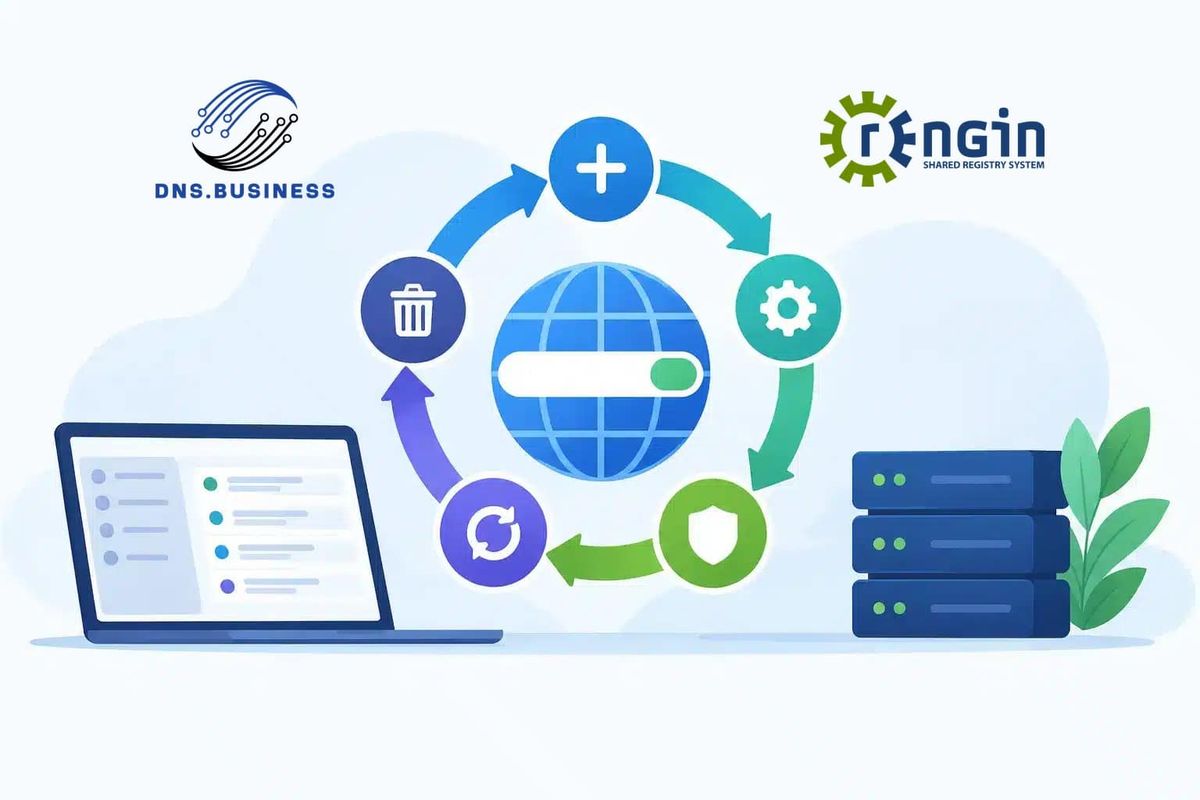
A domain that reaches expiration without the right renewal notice, billing action, status update, or DNS control can become far more than a customer-service issue. It can create revenue leakage, reputational damage, abuse exposure, and avoidable operational risk. A domain lifecycle platform provides the control layer required to manage each domain state consistently, from registration and delegation through renewal, transfer, redemption, and deletion.
For registry operators and registrars, lifecycle management is not a single feature. It is a coordinated operating model spanning authoritative registration data, EPP transactions, policy rules, financial events, DNS delegation, customer notifications, compliance records, and reporting. The platform behind those processes must make the lifecycle predictable at scale while preserving the flexibility needed for different TLD policies, commercial models, and market requirements.
This is where rEngin comes in. rEngin SRS is the core registry engine from DNS.Business and the middle layer of the registry system: it brings together EPP, policy and transaction systems, ICANN gTLD and ccTLD compliance, RDDS through Whois and RDAP, and DNS and DNSSEC, running in high-availability production and OT&E environments. Two control panels are built on top of it. rEngin Console is where registry operators manage registrars, domains, and registry functions. rEngin Portal is where registrars and resellers manage their account, onboarding, and domain functions.
rEngin Portal version 3 is the latest release and is live at ZACR, RyCE, Gateway SRS, and Registry Africa, with ZARC next in line for the upgrade.
A Domain Lifecycle Platform Is More Than a Registry Database
A registry database records domain objects and their associated contacts, nameservers, statuses, and dates. That is essential, but it is not enough to operate a modern namespace. A domain lifecycle platform applies the rules, automation, integration, and operational visibility that turn those records into dependable services.
For example, a domain approaching expiration may require staged notices, a defined auto-renewal action, suspension or zone removal, a redemption period, restoration controls, and eventual purge. Each event must occur at the correct time, create an auditable record, and remain aligned with the registry’s published policies. When registrars, resellers, or enterprise teams interact with the system through APIs or portals, they must receive clear outcomes and consistent status information.
The same principle applies to registrations, transfers, updates, and deletions. A well-designed platform does not simply accept commands. It validates eligibility, applies policy, protects data integrity, triggers downstream processes, and exposes results that operators can verify.
The Lifecycle Must Reflect Policy, Not Just Code
Every namespace has its own operational reality. A ccTLD may apply local presence requirements, restricted registration rules, or specific dispute processes. A gTLD may require strict alignment with ICANN policy, rights-protection mechanisms, and registrar obligations. A branded or regulated namespace may demand approval workflows and tighter access controls.
A platform should make these rules configurable wherever possible. Hard-coding policy into core workflows may appear efficient at launch, but it becomes costly when registration rules change, new product tiers are introduced, or regulatory requirements evolve. Configurable lifecycle parameters, validation rules, fees, grace periods, and notification schedules give operators control without forcing a disruptive redevelopment cycle.
That flexibility must have boundaries. Excessive customization can make upgrades difficult and introduce inconsistent behavior. The right approach is a stable core with policy-driven configuration, clear governance, and controlled extensions for genuinely unique requirements.
In rEngin, EPP and the policy and transaction systems sit together in rEngin SRS, the core engine, so lifecycle rules are applied in one place, while registry operators manage registrars, domains, and registry functions from rEngin Console. For a practical look at defining these rules, see our guide on how to configure domain lifecycle policies.
The Operational Capabilities That Matter
A domain lifecycle platform should be evaluated as mission-critical infrastructure. The key question is not whether it can create a domain record. The question is whether it can sustain accurate, secure operations across millions of transactions and changing policy conditions.
Lifecycle Automation and Scheduled Events
Date-driven automation is central to domain operations. Registration terms, renewals, expirations, grace periods, redemption windows, and deletion schedules all depend on precise timing. The platform should execute these events reliably, including during peak transaction periods and planned maintenance windows.
Operators also need the ability to define what happens at each stage. A domain may remain in the zone during part of its renewal process, be removed at a specific status, or follow different rules depending on its product category. Automation should reduce manual intervention, not remove operational control.
Standards-Based Integration
For registries, EPP remains a critical interface for registrar connectivity. A lifecycle platform should support secure, standards-aligned EPP services with extension capabilities appropriate to the registry’s policies. Registrars and resellers, meanwhile, need APIs and management interfaces that support provisioning, renewal, transfer, DNS management, contacts, billing, and reporting. On registries running rEngin, registrars and resellers handle their account, onboarding, and domain functions in rEngin Portal, built on top of the same rEngin SRS engine that serves their EPP connections.
Integration depth matters because domain events rarely stay inside one system. Lifecycle changes can affect billing platforms, CRM tools, abuse systems, DNS services, data escrow processes, analytics environments, and customer communications. An architecture with documented APIs, event handling, and reliable synchronization reduces the operational gaps that commonly emerge when disconnected tools are forced to work together.
DNS and Delegation Controls
Registration data and DNS behavior are related but distinct. A domain may be registered yet not delegated, delegated but suspended, or restored after a lifecycle event. The platform must accurately coordinate nameserver validation, zone generation, delegation status, and DNS provisioning without confusing registration state with resolution state.
This distinction becomes particularly important during expiration, abuse mitigation, and registry maintenance. Operators need to enforce policy-based DNS actions while preserving the evidence and audit trail needed to explain what happened, when it happened, and who authorized it.
rEngin SRS includes DNS and DNSSEC as part of the core registry engine, so delegation and zone behaviour follow the same lifecycle data as registrations. Our DNSSEC registry deployment guide covers the signing side in more detail.
Financial Integrity and Revenue Controls
Lifecycle operations have direct financial consequences. Auto-renewal, restore fees, transfer charges, promotional pricing, credits, and reseller balances must be calculated correctly and reconciled with domain events. A system that processes registrations accurately but leaves finance teams reconciling exceptions manually is not delivering full operational value.
The platform should support clear billing events, configurable fee structures, transaction histories, and reporting that enables both commercial and technical teams to work from the same source of truth. For registries operating through registrar channels, this visibility supports stronger partner relationships and faster resolution of disputed transactions.
Security, Compliance, and Accountability Are Built Into the Lifecycle
Domain infrastructure is a high-value target. Unauthorized updates, compromised registrar accounts, fraudulent transfers, and manipulation of DNS settings can have immediate consequences for registrants and the registry’s reputation. Security cannot sit outside the lifecycle platform as an afterthought.
Role-based access control, strong authentication, segregation of duties, transaction logging, and approval workflows help protect sensitive operations. Critical changes should be traceable to a user, system account, or automated process. Operators should also be able to distinguish between routine automation and exceptional actions that require human review.
Compliance requirements add another layer. Depending on the registry model, teams may need to manage registration data retention, privacy controls, audit reporting, data escrow, sanctions screening, abuse workflows, and contractual obligations. The exact requirements vary by jurisdiction and TLD policy, but the platform should provide the evidence, controls, and reporting needed to demonstrate accountable operations.
At the registry layer, rEngin SRS handles ICANN gTLD and ccTLD compliance and RDDS through Whois and RDAP as part of its core engine, keeping registration data, lifecycle events, and published records aligned.
Scalability Means More Than Handling More Domains
A platform can appear scalable when measured only by the number of domain records it stores. Real scale is demonstrated during simultaneous registrar connections, launch periods, promotional campaigns, bulk renewals, transfer surges, DNS updates, and scheduled lifecycle processing.
Performance must remain predictable when activity increases. That calls for capacity planning, monitoring, high availability, backup discipline, tested recovery procedures, and operational support from teams that understand domain transactions. It also requires sensible limits and safeguards so that one abnormal client pattern does not affect the wider registry service.
rEngin SRS runs in high-availability production and OT&E environments, so registrars can test integrations and lifecycle behaviour in OT&E before changes reach production. For a wider view of the same question, read what a domain registry must deliver at scale.
For a growing registry, the most valuable platform is one that can support the first thousand domains without creating a ceiling at one million. For an established operator, modernization should improve automation and visibility without placing existing data or partner connectivity at unnecessary risk.
Migration Is a Lifecycle Test, Not a Data Import
Registry migration exposes the difference between a software product and an operational platform. Moving domain records is only part of the work. The transition must preserve statuses, registration periods, auth information, contacts, nameservers, billing balances, policy history, registrar credentials, and scheduled events.
A disciplined migration begins with data assessment and mapping, followed by cleansing, rehearsal, reconciliation, and controlled cutover planning. Parallel validation is essential. Operators need confidence that the domain count is correct, but they also need proof that the lifecycle behavior is correct after go-live.
Migration trade-offs should be addressed openly. A fast cutover can reduce the duration of transition work but may increase pressure on registrar support teams. A longer parallel process can reduce some operational uncertainty but adds complexity and cost. The right model depends on registry size, data quality, integration dependencies, and acceptable service windows.
For a step-by-step view of planning the move, see our domain registry migration guide.
Choosing the Right Platform Partner
Technology selection should start with operational questions. Can the provider support the TLD’s policy model? Does it understand registry-registrar relationships and EPP operations? Can it provide migration expertise, security controls, service management, and a credible roadmap as the namespace grows?
Decision-makers should also look beyond demonstrations. Ask how lifecycle jobs are monitored, how failed transactions are recovered, how configuration changes are governed, how data is reconciled, and what support is available during high-risk events. These details determine whether a platform will enhance daily operations or create a new layer of dependency and manual work.
Transparency is a useful test of any provider. rEngin SRS is in continuous development, with regular updates and improvements, and its version numbers are published openly on the login pages, so operators and registrars can always see which release they are using. You can also see both control panels in action: walkthroughs are available for rEngin Portal and rEngin Console, and our rEngin Portal and Console walkthroughs article gives an overview.
DNS.Business approaches domain lifecycle management as specialized registry infrastructure, combining domain-industry technology with the operational support required by registries, registrars, resellers, and enterprise namespace owners. That is why rEngin is built with rEngin SRS as the core engine, rEngin Console for registry operators, and rEngin Portal for registrars and resellers. The objective is not simply to process domain commands. It is to give operators dependable control over the full domain journey.
The most useful next step is to map your current lifecycle from registration to deletion and identify every point where a manual handoff, disconnected system, or unclear policy decision can interrupt service. Those points define the requirements your platform must solve first. To see how rEngin manages the full domain lifecycle, from rEngin SRS at the core to rEngin Console and rEngin Portal on top, visit renginsrs.com.